5 Hiring Mistakes Startups Make (And How to Fix Them)
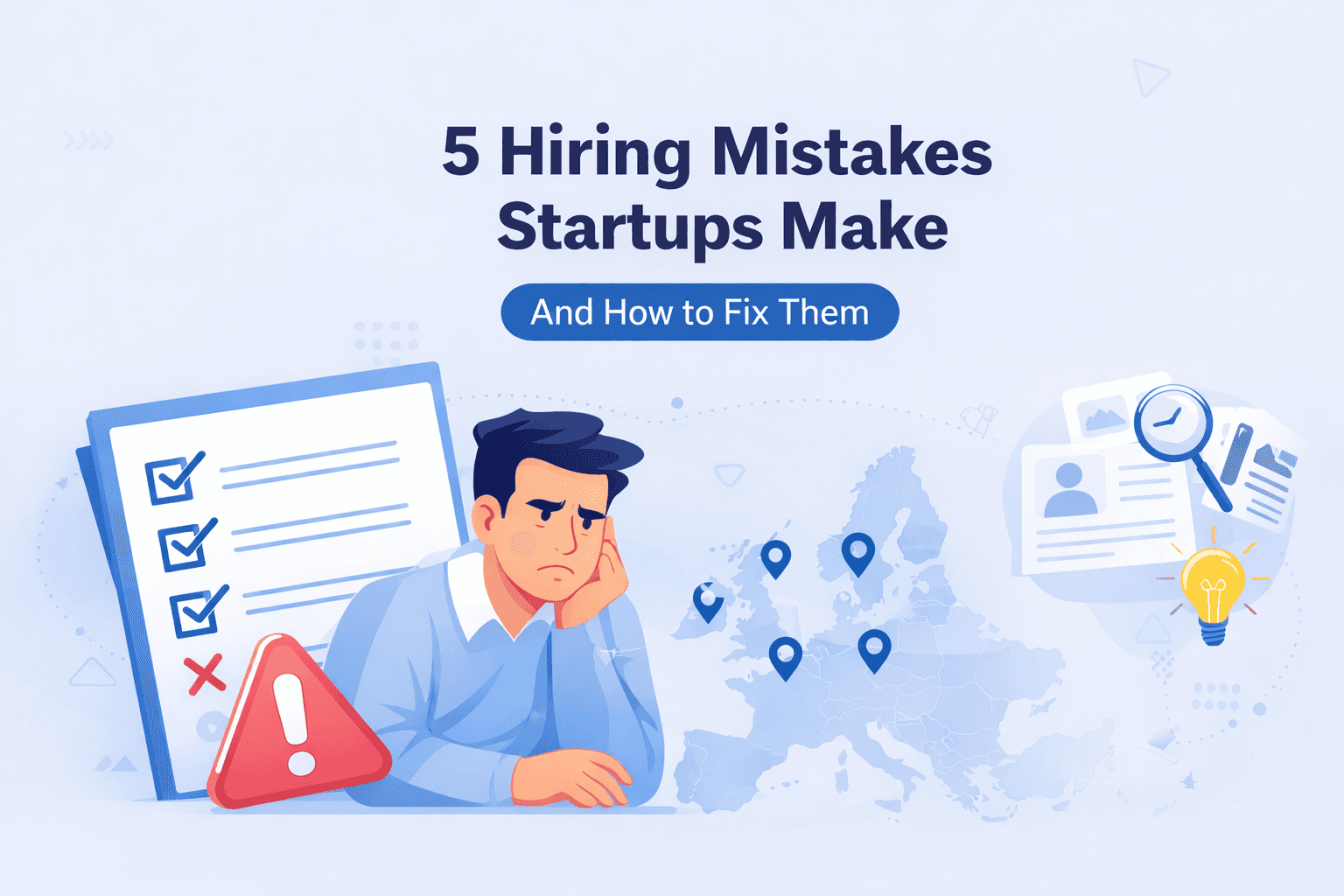
Hiring in a European startup or scaleup moves fast. But speed often leads to one critical problem: You’re hiring for yesterday’s version of the role.
Across Germany, the UK, the Netherlands, Spain, and beyond, we see the same patterns repeated. And in a tighter 2026 hiring market, these mistakes are expensive.
Here are five common hiring mistakes startups in Europe are still making — and how to avoid them.
1. You’re copying last year’s job description
If you’re using a job description from 2024 (or even early 2025), there’s a good chance it no longer reflects:
Your current growth stage
Your product maturity
Your market positioning
Your internal team structure
European startup hiring trends show a clear shift toward leaner, more impact-driven teams. Roles evolve quickly.
Fix it:
Before posting a job, ask:
What outcomes must this person deliver in 12 months?
What has changed in the business since the last hire?
What will this role look like if we double in revenue?
Hiring in 2026 requires designing roles for where your company is going — not where it has been.
2. You’re prioritizing years of experience over problem-solving ability
Many founders across Europe still filter candidates by:
“5+ years required”
Specific industry background
Linear career paths
But in competitive markets like Berlin, London, Amsterdam, and Barcelona, this approach shrinks your talent pool.
Time served ≠ value delivered.
Fix it:
Shift toward skills-based hiring:
Use practical assessments.
Evaluate how candidates think.
Ask for real case examples.
European hiring is increasingly moving toward adaptability and capability over credentials. If you’re not, you’re missing high-potential talent.
3. Your “Must-Have” list is unrealistic
If your job ad includes 15+ requirements, you’re not hiring a person — you’re searching for a unicorn.
This is one of the most common startup hiring mistakes in Europe.
Overloaded job descriptions:
Slow down applications
Deter strong candidates
Create false selection criteria
Fix it:
Separate:
True non-negotiables (3–5 max)
Skills that can be learned within 3–6 months
Traits tied to outcomes (ownership, execution, adaptability)
The best European scaleups hire for trajectory — not perfection.
4. You’re ignoring non-traditional talent
The strongest candidates don’t always follow predictable career paths.
Across Europe, especially in tech and commercial roles, we’re seeing:
Career switchers outperforming traditional hires
Self-taught engineers delivering at senior levels
Operators moving across industries successfully
If you only hire from “expected” backgrounds, you narrow your competitive edge.
Fix it:
Look for:
Evidence of learning speed
Ownership in previous roles
Results achieved, not just titles held
In 2026, unconventional talent is often your advantage.
5. You’re hiring for tasks, not outcomes
This is the biggest strategic mistake.
Many European startups describe roles in terms of:
Responsibilities
Processes
Day-to-day activities
But top candidates think in terms of:
Impact
Autonomy
Growth
Business outcomes
When you hire for tasks, you attract operators.
When you hire for outcomes, you attract builders.
Fix it:
Rewrite job descriptions to include:
Clear success metrics (What does great look like in 12 months?)
Business impact
Cross-functional influence
Strategic contribution
Hiring for impact is what separates reactive teams from high-growth ones.
Hire for Tomorrow, Not for Comfort
European hiring in 2026 is more competitive, more transparent, and more strategic than ever.
If you’re building a startup or scaling across Germany, the UK, the Netherlands, Spain, or other European markets, your hiring strategy must evolve.
Stop asking:
“Who fits this old job description?”
Start asking:
“Who will help us reach the next stage of growth?”
That shift alone changes everything.
About Berg Search
Berg Search partners with founders and scaleups across Europe to design and execute hiring strategies aligned with growth.
We don’t just fill roles.
We help you define them properly, so you hire for tomorrow.