AI in Recruitment: A Practical Guide for Startups & Scaleups
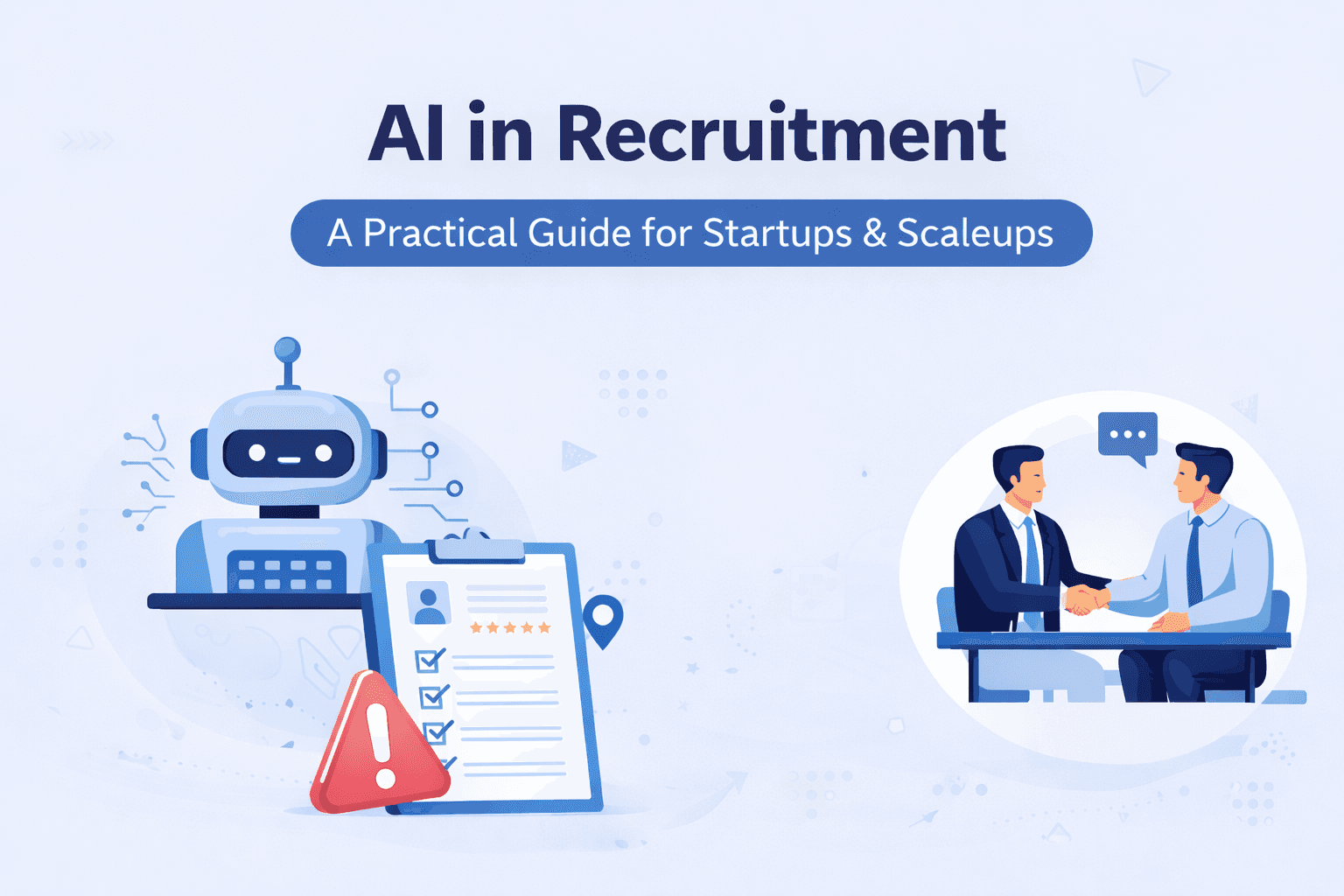
AI in recruitment is no longer experimental. Across Europe and globally, startups and scaleups are already using AI tools to:
Screen CVs
Automate candidate outreach
Draft job descriptions
Schedule interviews
Rank applicants
But here’s the real question: Should AI be making your hiring decisions?
In 2026, the answer is clear: Use AI as an assistant - not a replacement.
Here’s what founders and hiring managers need to know.
Why AI in recruitment is growing fast
Startups are under pressure to:
Reduce time to hire
Lower recruitment costs
Improve hiring efficiency
Compete with larger companies
AI tools promise exactly that.
Common AI recruitment use cases include:
Automated CV screening
Talent sourcing via AI-driven search
Chatbots for candidate communication
Predictive analytics for candidate matching
Writing optimized job descriptions
For lean hiring teams, this is powerful.
Used correctly, AI can:
Cut administrative workload
Speed up early-stage screening
Improve response times
Provide data-backed insights
But speed isn’t the same as accuracy.
The risks of overusing AI in hiring
Many startups assume that more automation equals better hiring.
That’s not always true.
1. Algorithmic Bias
AI systems learn from historical hiring data.
If your past hiring patterns were biased (even unintentionally), AI can reinforce those patterns — at scale.
This can impact:
Gender diversity
Cultural diversity
Non-traditional candidates
Career switchers
For European startups operating under increasing regulatory scrutiny, this is a real risk.
2. Filtering out high-potential talent
AI screening tools often rely on:
Keyword matching
Degree requirements
Specific experience signals
But high-growth startups often benefit from:
Adaptability
Learning speed
Ownership mindset
Problem-solving ability
These qualities are difficult to measure algorithmically. Some of the best hires don’t look perfect on paper.
3. Losing the human element
Hiring is not just evaluation.
It’s persuasion.
Top candidates - especially in tech and commercial roles - choose companies based on:
Vision
Leadership
Culture
Trust
AI cannot build trust.
Relationships still win talent.
Where AI does add real value in recruitment
The smartest startups don’t avoid AI.
They use it strategically.
Here’s where AI in recruitment works best:
✅ Administrative Automation
Interview scheduling
Email follow-ups
Application tracking
Data organization
This frees up recruiters and founders to focus on high-value conversations.
✅ Talent Mapping and Sourcing
AI can scan:
Public talent databases
Professional networks
Open-source contributions
It helps uncover passive candidates faster than manual search.
✅ Job Description Optimization
AI can:
Improve clarity
Remove biased language
Suggest SEO-friendly phrasing
Align with pay transparency standards
Especially in European markets, where regulatory compliance matters, this is useful.
The hybrid model: Human + AI
The future of recruitment in 2026 isn’t:
Human vs. AI. It’s human + AI.
Think of AI as:
A research assistant
A process optimizer
A data tool
But final decisions should remain human-led.
Founders and hiring managers must still assess:
Cultural alignment
Ambition and ownership
Communication style
Long-term growth potential
These are judgment calls — not algorithm outputs.
AI and the European Regulatory Landscape
Across Europe, hiring practices are increasingly regulated.
With frameworks like:
The EU Pay Transparency Directive
Growing AI regulation discussions
Data protection standards (GDPR)
Startups must ensure:
AI tools comply with data privacy rules
Decision-making processes remain transparent
Candidates are treated fairly
Blind automation without oversight can create legal exposure. Responsible AI use is not just ethical - it’s strategic.
How Startups Should Approach AI in Recruitment in 2026
If you’re building a hiring strategy this year, here’s a practical framework:
1. Automate the repetitive
2. Humanize the critical
3. Audit your tools regularly
4. Avoid fully automated rejection systems
5. Prioritize skills-based assessment
The goal isn’t maximum automation.
It’s maximum clarity.
Final Thought: Don’t Optimize Yourself Out of Great Talent
AI can accelerate hiring.
But over-optimization can eliminate nuance.
In competitive markets like Germany, the UK, the Netherlands, Spain, and beyond, the best candidates want:
Human interaction
Clear communication
Thoughtful evaluation
Respectful processes
Technology should enhance your hiring experience — not replace it.
About Berg Search
Berg Search partners with startups and scaleups to build modern, high-impact hiring strategies across Europe.
We integrate smart processes and technology — without losing the human judgment that great hiring requires.
If you’re exploring how to incorporate AI into your recruitment strategy, we’re happy to help.