Hiring Trends 2026: What Startups & Scaleups Must Know
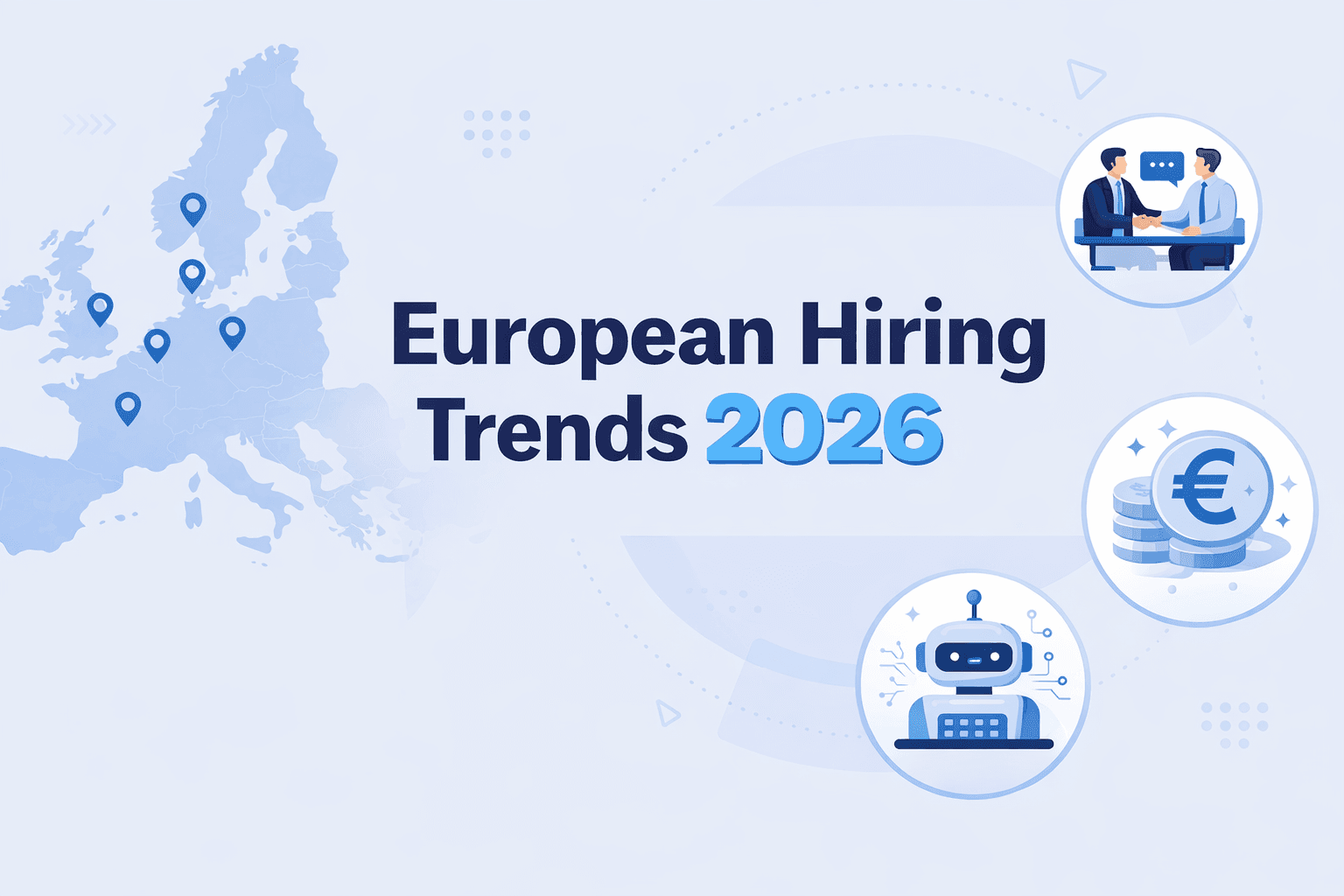
If you’re hiring in Europe in 2026, the rules have changed.
The market is more cautious. Regulation is tighter. Competition for technical talent remains intense. And AI is reshaping recruitment workflows faster than most companies can adapt.
For founders and hiring managers across European startups and scaleups, this isn’t a year for reactive hiring. It’s a year for smart adaptation.
Here are the five hiring trends in Europe you can’t afford to ignore in 2026.
1. Europe’s employment outlook is slower - but more strategic
Recent employment outlook data shows that EMEA continues to report one of the lowest global hiring outlooks (around 20%), with significant regional variation.
Top-performing regions and sectors include:
The Netherlands (strong outlook in Consumer Goods)
Belgium (Finance sector growth)
Spain (IT hiring momentum increasing)
IT and Finance sectors remain consistently strong across Europe
What this means for startups and scaleups
Hiring volume is no longer the signal of growth - quality is.
Investors and boards are pushing for:
Revenue efficiency
Leaner teams
Strategic, high-impact hires
Instead of hiring aggressively, European startups are prioritizing:
Revenue-generating roles (BDR, Account Executive)
Technical hires tied directly to product velocity
Leadership roles that unlock scale
If you're building your 2026 hiring strategy, the question isn’t:
“How many people do we need?”
It’s:
“Which hire will move the business forward the most?”
2. The EU Pay Transparency Directive changes hiring forever
One of the most important regulatory changes affecting European recruitment is the EU Pay Transparency Directive, with a compliance deadline of June 7, 2026.
Key requirements include:
Salary ranges must be included in job advertisements
Ban on pay secrecy clauses
Gender pay gap reporting (for companies with 150+ employees starting June 2027)
This affects companies operating across Germany, the UK (in parallel with local transparency trends), the Netherlands, Spain, France, and beyond.
Why this matters for founders
Pay transparency impacts:
Your employer brand
Candidate trust
Compensation benchmarking
Internal equity
Startups that delay preparation risk:
Misaligned salary bands
Internal dissatisfaction
Slower hiring processes
Damaged reputation in competitive markets
Forward-thinking scaleups are already:
Standardizing salary frameworks
Auditing pay gaps
Aligning compensation with market benchmarks
Training hiring managers to discuss compensation confidently
In 2026, salary transparency isn’t optional. It’s infrastructure.
3. The tech talent shortage in Europe is still real
Despite a more cautious hiring market, IT remains one of the strongest hiring sectors globally (around 37%).
But here’s the paradox:
Hiring volume may slow,
Finding top tech talent is harder than ever.
Why?
Cross-border hiring has become standard.
Top engineers receive multiple international offers.
Remote-first teams widen competition beyond local markets.
The shift: skills over credentials
European startups are increasingly:
Testing real-world skills instead of filtering by degrees
Prioritizing adaptability and problem-solving
Hiring beyond traditional career paths
The best candidates may not have:
The “perfect” CV
A linear career history
A prestigious university degree
But they can build, ship, and solve.
In 2026, the real question is no longer:
“Where did they study?”
It’s:
“Can they deliver?”
4. AI in recruitment is rising - but human judgment still wins
AI in recruitment is no longer experimental.
European startups are already using AI tools for:
CV screening
Interview scheduling
Candidate outreach
Job description drafting
Talent sourcing
AI speeds up administrative processes significantly.
But here’s where companies get it wrong:
AI can optimize workflows.
It cannot assess culture, ambition, ownership, or long-term fit.
Over-reliance on automated filtering risks:
Missing unconventional high-potential candidates
Reinforcing bias in historical hiring data
Removing human nuance from decision-making
The strongest hiring teams in Europe use AI as:
An assistant
A data processor
A time-saver
Not as a decision-maker.
In high-growth environments, final hiring decisions still require experienced human judgment.
5. Mid-to-large companies are driving European hiring
Companies with 250–999 employees are reporting some of the highest hiring outlooks in Europe, followed closely by larger organizations.
For startups and early-stage scaleups, this creates a competitive challenge:
You’re not just competing with other startups.
You’re competing with established, well-funded companies.
How startups can compete for talent in 2026
You may not win on:
Salary
Brand recognition
Stability
But you can win on:
Agility
Ownership
Speed of progression
Direct impact
Exposure to founders
Top candidates in Europe are increasingly motivated by:
Autonomy
Clear growth paths
Meaningful equity
Real responsibility
If your hiring strategy doesn’t clearly communicate this, you’ll lose strong candidates to safer options.
2026 is about Smart Adaptation
Across Germany, the UK, the Netherlands, Spain, France, and beyond, hiring in 2026 is defined by:
Regulatory change
Skills-based evaluation
Cross-border competition
AI-enabled processes
Strategic workforce planning
The companies that will win talent in 2026 are not the ones hiring the fastest.
They’re the ones hiring the smartest.
Building a 2026 hiring strategy that works
If you’re a founder or hiring manager in a European startup or scaleup, now is the time to:
Audit your compensation structures
Review your hiring processes
Shift from experience-based screening to skills-based evaluation
Clarify which hires directly drive growth
Adapt your employer value proposition to compete with mid-sized enterprises
Hiring in 2026 isn’t about volume.
It’s about precision.
About Berg Search
Berg Search partners with founders and scaling teams across Europe to build high-impact commercial, operational, and technical teams.
We work as embedded talent partners - helping startups and scaleups hire strategically, not reactively.
If you're planning your 2026 hiring roadmap and want clarity on where to focus, we’re happy to talk.